


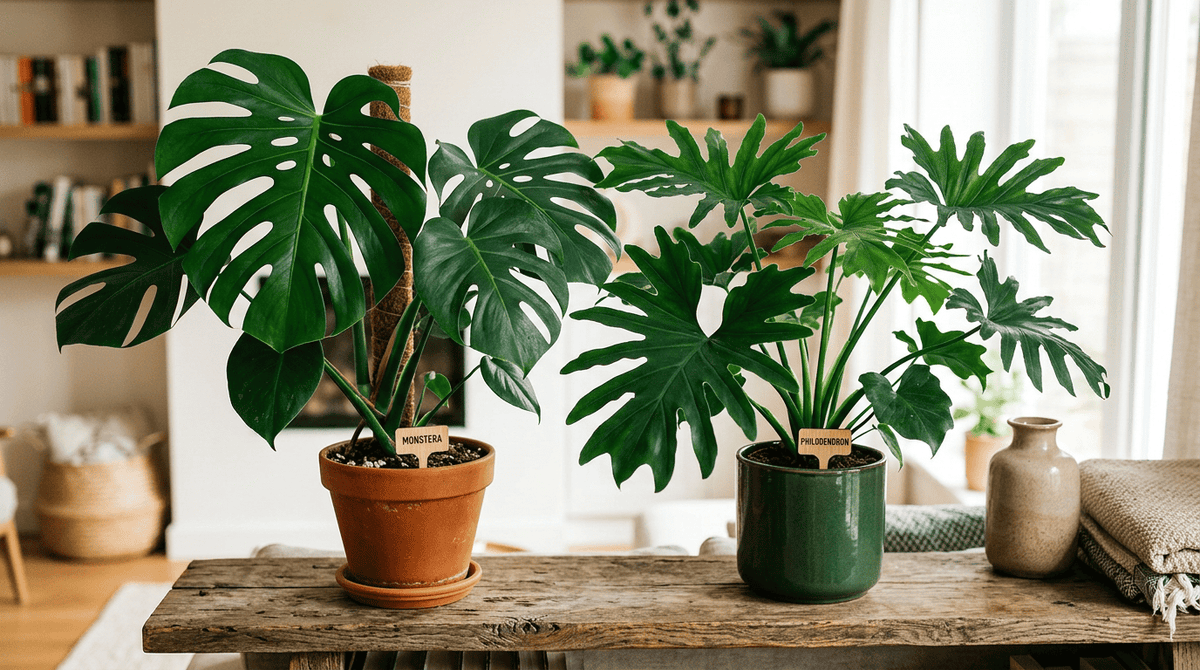
Monstera and Philodendron are not the same plant. They are separate genera within the same botanical family, Araceae.
The confusion comes from their similar tropical appearance and misleading common names. Monstera deliciosa is frequently called split-leaf philodendron, Swiss cheese philodendron, or Philodendron Monstera, even though it does not belong to the Philodendron genus.
The fastest way to identify a mature Monstera deliciosa is to examine its leaves. Monstera leaves can develop both splits along their edges and enclosed holes within the leaf surface. Most Philodendron leaves do not develop this combination.
Growth habit, stems, aerial roots, and the way new leaves emerge provide additional clues.
Is Monstera a Philodendron?
No. Monstera and Philodendron are different genera.
Both belong to the aroid family, Araceae, which explains some of their similarities. Members of this family share related flower structures, tropical origins, and certain growth characteristics.
Penn State Extension confirms that Monstera is not a Philodendron, although “split-leaf philodendron” and “cut-leaf philodendron” remain common names for Monstera deliciosa.
A plant sold as a Philodendron Monstera is usually Monstera deliciosa with an inaccurate or outdated label. Check the botanical name whenever possible.
Monstera vs. Philodendron at a Glance
| Feature | Monstera deliciosa | Philodendron |
|---|---|---|
| Genus | Monstera | Philodendron |
| Family | Araceae | Araceae |
| Mature leaves | May have edge splits and enclosed holes | Shape varies; most lack Monstera-style holes |
| Growth habit | Climbing vine | Climbing or self-heading, depending on species |
| Aerial roots | Thick and prominent | Present on many climbing species |
| New growth | Often protected by a temporary sheath | Frequently emerges from a persistent or falling cataphyll |
| Fruit | Mature plants can produce edible ripe fruit | Not grown for edible fruit |
| Common naming issue | Often mislabeled as split-leaf philodendron | Name covers hundreds of different species |
Because Philodendron is a large and varied genus, no single feature describes every species. Identification is easier when comparing Monstera deliciosa with a particular Philodendron rather than the entire genus.
How Can You Identify a Monstera?
A mature Monstera deliciosa typically has:
-
Large, glossy, heart-shaped leaves
-
Natural holes within the leaf blade
-
Deep splits extending inward from the edges
-
Thick climbing stems
-
Prominent aerial roots
-
Long leaf stalks
-
A joint or slightly wrinkled section where the leaf meets its stalk
The enclosed holes are called fenestrations. They are one of the clearest differences between a mature Monstera and plants with leaves that are only lobed along the edges.
Young Monstera leaves can be more difficult to identify because they may be small and completely solid. Fenestrations generally become more pronounced as the plant matures under favorable conditions.
Our guide to why Monstera leaves develop splits and holes explains this maturation process.
What Does a Philodendron Look Like?
Philodendron includes hundreds of species with many different forms.
Some Philodendrons are trailing vines with small heart-shaped leaves. Others climb supports and develop large foliage. Self-heading types grow upright from a compact center rather than producing a long climbing vine.
Common examples include:
-
Heartleaf Philodendron
-
Philodendron ‘Brasil’
-
Philodendron ‘Birkin’
-
Philodendron ‘Pink Princess’
-
Philodendron gloriosum
-
Philodendron melanochrysum
North Carolina Extension describes Philodendron as a genus containing both climbing and non-climbing plants. Depending on the species, mature size can range from a compact houseplant to a substantial tropical specimen.
Unlike Monstera deliciosa, most Philodendrons do not develop enclosed holes within their leaves. They may have smooth, heart-shaped, elongated, or deeply lobed foliage instead.
How Can You Identify a Young Monstera?
Juvenile Monstera plants often lack the holes and deep splits that make mature plants easy to recognize. Their leaves may be solid, heart-shaped, and similar to those of a young climbing Philodendron.
Look beyond the leaf shape. A young Monstera deliciosa usually has thicker stems and leaf stalks than a common heartleaf Philodendron. As it grows, it develops strong aerial roots and increasingly large leaves. It also tends to need a substantial support rather than trailing delicately from a hanging basket.
Observe new leaves over time. A healthy young Monstera receiving enough light and climbing support should gradually produce larger foliage. Fenestrations may begin as a few small openings or shallow splits before becoming more complex.
Do not identify a juvenile plant based on one leaf. Examine its stem, growth direction, aerial roots, leaf texture, and newest growth together.
What Is a Split-Leaf Philodendron?
“Split-leaf philodendron” is an especially confusing common name because it has been applied to more than one plant.
It is often used for Monstera deliciosa. It may also refer to tree philodendron, currently classified as Thaumatophyllum bipinnatifidum and formerly known as Philodendron bipinnatifidum or Philodendron selloum.
Tree philodendron differs from Monstera in several visible ways:
-
It grows from a thick, self-supporting trunk
-
Its leaves are deeply lobed
-
Its leaves generally lack enclosed Monstera-style holes
-
It forms a broad, shrub-like plant rather than a climbing vine
-
Old leaf scars create distinctive patterns on its trunk
Current UF/IFAS plant guidance identifies tree philodendron as Thaumatophyllum bipinnatifidum. Scientific names are therefore more reliable than common names when shopping for or identifying these plants.
Swiss Cheese Plant vs. Monstera Deliciosa: Are They Different?
In most cases, Monstera deliciosa and Swiss cheese plant are two names for the same plant.
The common name refers to the holes that develop in mature Monstera leaves. Monstera adansonii may also be called Swiss cheese plant or Swiss cheese vine, which creates additional confusion.
A Monstera deliciosa generally produces larger leaves with both interior holes and deep edge splits. Monstera adansonii has smaller leaves containing numerous enclosed holes but usually lacks the dramatic edge splitting associated with a mature deliciosa.
When comparing Monstera deliciosa vs. Swiss cheese plant, check whether the label includes a botanical name. If it says Monstera deliciosa, there is no difference—the two names describe the same plant.
Is Swiss Cheese Plant a Philodendron?
No. Swiss cheese plant most commonly refers to a Monstera.
“Swiss cheese philodendron” is a popular retail and search phrase, but it does not represent a recognized Philodendron species. A plant sold under that name is likely a Monstera deliciosa or Monstera adansonii.
Similarly, a label reading “Swiss cheese philodendron plant” is probably using an inaccurate common name for a Monstera. Examine the foliage and botanical label before following Philodendron-specific care instructions.
Do Monstera and Philodendron Grow Differently?
Monstera deliciosa is a climbing vine that uses thick aerial roots to attach to trees or supports. Indoors, it benefits from a moss pole, wooden board, or sturdy trellis.
Philodendron growth varies by species. Heartleaf Philodendron trails or climbs on slender stems. Self-heading cultivars such as ‘Birkin’ grow from a compact center. Other climbing Philodendrons produce substantial leaves when trained vertically.
Their natural forms affect placement and maintenance. A Monstera may eventually require significant floor space and strong support, while a small vining Philodendron may fit comfortably on a shelf or in a hanging basket.
Do Monstera and Philodendron Need the Same Care?
Their care can be similar, but identification still matters.
Many tropical Monsteras and Philodendrons prefer:
-
Bright, indirect light
-
Warm temperatures
-
A well-draining growing medium
-
Thorough watering followed by partial drying
-
Moderate to high humidity
-
Protection from cold and intense sunlight
Exact requirements vary by species. A compact self-heading Philodendron does not grow like a climbing Monstera, and some Philodendrons tolerate lower light better than Monstera deliciosa.
For proper Philodendron Monstera care, first confirm which plant you own. Then use care information written for its botanical name.
For Monstera deliciosa, begin with our complete Monstera care guide, watering guide, and Monstera light requirements.
Which Plant Gets Bigger?
Both groups include large plants, but Monstera deliciosa is particularly well known for its mature size.
Indoors, a supported Monstera may reach approximately 6 to 8 feet tall and spread several feet wide. In tropical conditions, its climbing vine can extend much farther.
Philodendron size varies dramatically by species. A heartleaf Philodendron may remain relatively slender, while some climbing and self-heading species become substantial plants.
Our guide to how big a Monstera gets explains its growth rate and how to control its size indoors.
Frequently Asked Questions
Is Monstera Deliciosa a Philodendron?
No. Monstera deliciosa belongs to the genus Monstera. Philodendrons belong to the separate genus Philodendron.
Why Is Monstera Called Split-Leaf Philodendron?
The name developed because the plants have a similar tropical appearance and belong to the same family. It remains common even though it is botanically inaccurate.
Is a Swiss Cheese Plant the Same as Monstera?
Usually, yes. Swiss cheese plant commonly refers to Monstera deliciosa, while Swiss cheese vine often refers to Monstera adansonii.
What Is the Easiest Way to Tell Them Apart?
Look for enclosed holes within a mature leaf. Monstera deliciosa develops both holes and edge splits. Most Philodendron leaves do not.
Is Mini Monstera a Philodendron?
No. The plant sold as mini Monstera is usually Rhaphidophora tetrasperma. It is neither a true Monstera nor a Philodendron.
Are Monstera and Philodendron Toxic?
Both contain irritating calcium oxalate crystals and should be kept away from pets and children. Our future guide to Monstera toxicity for people and pets will explain the risks in detail.
Check the Botanical Name
Monstera and Philodendron are related, but they are not interchangeable names.
A mature Monstera deliciosa can usually be identified by its climbing growth, prominent aerial roots, and leaves with both splits and enclosed holes. Philodendron includes a much wider range of climbing and self-heading plants, most without Monstera-style fenestrations.
When labels such as Philodendron Monstera, Swiss cheese philodendron, or split-leaf philodendron create confusion, check the botanical name before choosing a care routine.
Explore our nursery-grown Monstera deliciosa plants and bring unmistakable Swiss cheese foliage into your home.


