


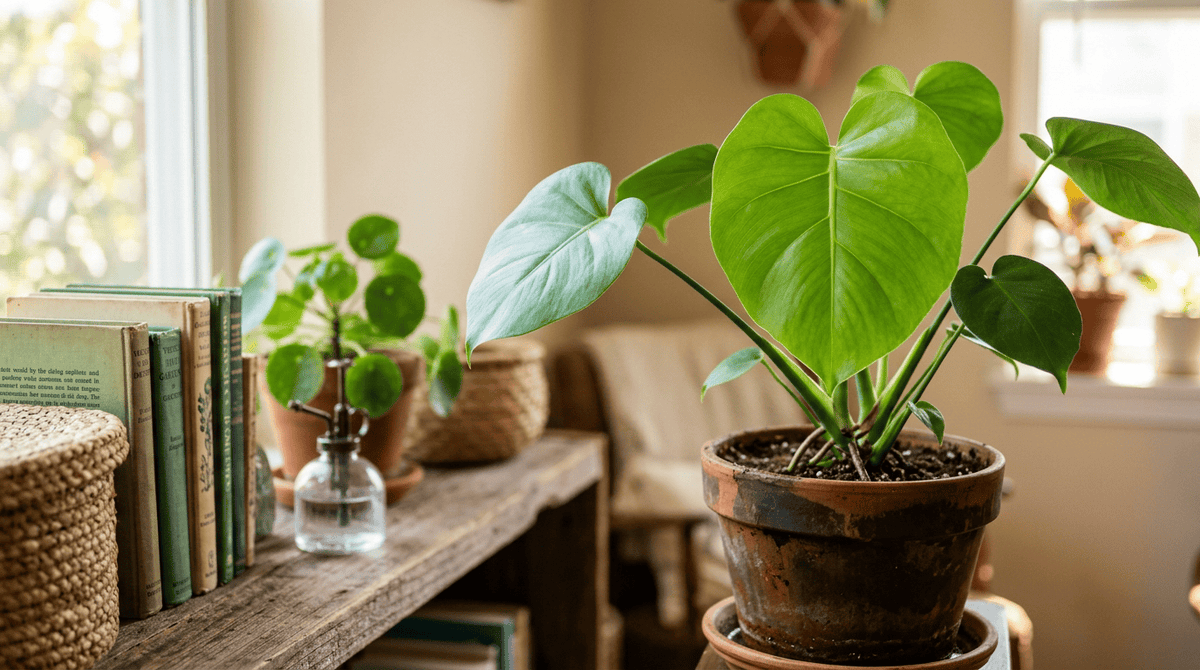
A Monstera without splits or holes is usually young, receiving insufficient light, or growing without something to climb. It may also be recovering from stress or producing smaller leaves because its overall growing conditions have changed.
The holes and edge splits in a mature Monstera leaf are called fenestrations. They develop as the plant matures; a solid leaf will not suddenly split after it has unfurled.
To encourage fenestrated growth, provide bright indirect light, a sturdy climbing support, consistent watering, healthy roots, and time. The goal is to improve future leaves rather than change existing ones.
What Is Monstera Fenestration?
Monstera fenestration is the natural development of openings and divisions in the plant’s leaves.
Two principal forms appear on Monstera deliciosa:
-
Interior fenestrations: Enclosed holes within the leaf blade
-
Edge splits: Open divisions extending inward from the leaf margin
Young Monstera leaves are generally small, heart-shaped, and solid. As the plant matures, new leaves may first develop a few edge splits, followed by interior holes and increasingly complex patterns.
North Carolina Extension confirms that only mature leaves develop Monstera’s characteristic holes and deep divisions.
“Split leaf Monstera” and “Swiss cheese plant” are common names inspired by this mature foliage. They do not mean every leaf will be fenestrated.
When Do Monstera Leaves Split?
There is no exact age when all Monstera leaves begin splitting.
A healthy plant may produce its first fenestrations after developing several juvenile leaves, but timing depends on its maturity, light, support, and growing conditions. A young cutting taken from mature growth may also fenestrate sooner than a seed-grown juvenile plant.
Instead of relying on the plant’s age, look for signs of progression:
-
Each new leaf is larger than the previous one
-
The stem is becoming thicker
-
Aerial roots are developing
-
The plant is climbing
-
New leaves begin showing shallow edge divisions
-
Later leaves develop enclosed holes
If each new leaf is the same size or smaller, the plant may not have enough energy or support to advance into mature growth.
Monstera Fenestration Stages
Monstera fenestration stages are gradual rather than tied to a fixed timeline.
A typical progression looks like this:
-
Juvenile leaves: Small, solid, and heart-shaped
-
First splits: Shallow divisions develop along the leaf edge
-
Deeper edge fenestrations: Splits extend closer to the center
-
Interior holes: Enclosed openings form near the midrib
-
Mature fenestration: Leaves develop multiple holes and deep edge splits
-
Secondary fenestration: Additional rows of interior holes appear
Not every plant follows this pattern exactly. Genetics, maturity, environmental conditions, and whether the plant is climbing all influence leaf development.
The term “Monstera double fenestration” usually describes a mature leaf with more than one row of interior holes. Secondary fenestration in Monstera generally appears only after the plant has produced large, mature foliage.
Why Does My Monstera Have No Splits?
Several factors can keep new leaves small or solid.
The Plant Is Still Young
Juvenile Monstera deliciosa naturally produces leaves without holes. No treatment can force a very young plant to become mature immediately.
Focus on steady growth. If each new leaf is larger, the plant is progressing even if fenestrations have not appeared yet.
It Needs More Light
Insufficient light is one of the most common reasons a Monstera stops producing larger, fenestrated leaves.
A plant in low light may survive, but its growth can become slow, stretched, and juvenile. Wisconsin Horticulture notes that Monstera may not develop leaf perforations when light is inadequate.
Move the plant toward brighter indirect light, making changes gradually to avoid sunburn. Our guide to Monstera light needs and requirements explains how to select the right window.
It Is Not Climbing
Monstera deliciosa is a climbing vine. In nature, it attaches to tree trunks with aerial roots and produces larger foliage as it climbs.
A plant trailing across the floor or leaning without support may continue growing but produce smaller leaves. Penn State Extension notes that upright growth on a support encourages larger, greener leaves with mature fenestrations.
A moss pole, wooden plank, or sturdy trellis can provide the vertical structure it needs. Our upcoming guide to Monstera aerial roots and plant support will explain how to train it safely.
Its Roots Are Stressed
Damaged roots cannot supply enough water and nutrients for vigorous leaf growth.
Possible causes include:
-
Constantly wet soil
-
Severe or repeated drought
-
Dense, poorly draining growing medium
-
An oversized container
-
A badly root-bound plant
-
Recent repotting or root damage
Follow a consistent routine using our Monstera watering guide. If the plant dries within a day or roots crowd the container, review when to repot a Monstera.
The Plant Recently Changed Environments
Shipping, relocation, repotting, propagation, or a major lighting change can interrupt mature growth.
A propagated top cutting may initially produce a smaller leaf while establishing roots. Once the plant adjusts and begins climbing again, leaf size and fenestration can increase.
Give it stable conditions rather than repeatedly moving or repotting it.
How Do You Encourage Monstera Fenestration?
To encourage future leaves to split:
-
Provide bright indirect light. Move the plant closer to a suitable window or add a grow light.
-
Give it sturdy support. Position the back of the stem against a moss pole, plank, or trellis.
-
Attach the stem correctly. Secure the main stem loosely; do not tie or restrain the moving leaf stalks.
-
Water according to the soil. Water thoroughly after the upper 1 to 2 inches have dried.
-
Maintain healthy roots. Use a well-draining medium and a container with drainage holes.
-
Feed during active growth. Apply an appropriate houseplant fertilizer without exceeding its directions.
-
Be patient. Evaluate the progression of several new leaves rather than expecting the next one to become fully mature.
Avoid cutting healthy solid leaves merely because they lack holes. Those leaves still photosynthesize and provide energy for future growth.
Our complete Monstera deliciosa care guide brings these growing conditions together.
Why Did My Monstera Stop Producing Fenestrations?
A mature plant can revert to smaller or less fenestrated growth when conditions decline.
Common causes include:
-
Moving into lower light
-
Removing its climbing support
-
Root damage
-
Underwatering or overwatering
-
A long period without nutrients
-
Propagation or severe pruning
-
Seasonal slowing during winter
Compare the plant’s current location and care with the conditions it received when its mature leaves developed.
Older fenestrated leaves do not guarantee that every future leaf will be equally complex. Restoring strong light, support, and root health should help later growth recover.
Does Every Monstera Develop Holes?
Not every plant called “Monstera” develops the same leaf pattern.
Monstera deliciosa can develop large leaves with edge splits and interior holes. Monstera adansonii typically produces smaller leaves with numerous enclosed openings. Other species have different mature forms.
A plant that never develops holes may also have been mislabeled. Our guide to Monstera vs. Philodendron identification explains how to distinguish Monstera deliciosa from commonly confused tropical plants.
Frequently Asked Questions
Will Existing Monstera Leaves Develop Splits?
No. A leaf’s fenestration pattern is established before it unfurls. Improved care affects future growth, not existing leaves.
Should I Cut Off Monstera Leaves Without Holes?
No. Healthy solid leaves supply energy to the plant. Remove them only if they become badly damaged, diseased, or naturally decline.
Do Monstera Leaves Split as They Unfurl?
The holes and splits already exist within the tightly rolled new leaf. They become visible as it opens.
How Long Does It Take a Monstera to Fenestrate?
There is no fixed timeline. Some plants develop splits after several juvenile leaves, while others take much longer because of age, light, support, or growing conditions.
What Is Double Fenestration in Monstera?
Double fenestration describes mature foliage with multiple rows of enclosed holes. It generally develops on large leaves from mature, well-supported plants.
Can a Monstera Lose Its Fenestrations?
Existing leaves will retain their holes, but new leaves may have fewer fenestrations when the plant experiences lower light, stress, or loss of support.
Focus on the Next Leaf
If your Monstera has no splits or holes, first consider its age, light, climbing support, and root health.
Healthy solid leaves should remain on the plant. Improve the growing environment and watch whether each new leaf becomes larger and more mature.
With bright indirect light, a sturdy support, consistent care, and patience, a young Monstera can gradually develop the dramatic fenestrations that make the species famous.
Explore our established Monstera deliciosa plants and enjoy watching each new leaf reveal its pattern.


