


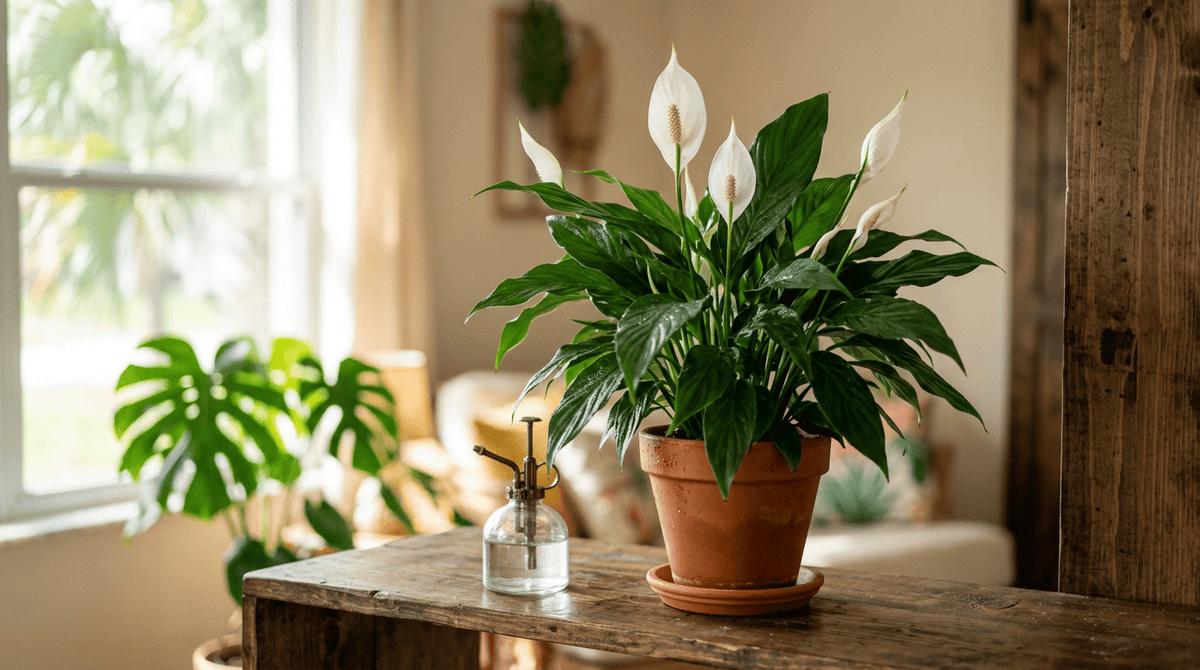
A Peace Lily does not always need distilled water. Many grow successfully with ordinary tap water, but distilled water may help when a plant repeatedly develops brown leaf tips because of fluoride, softened water, or mineral and salt buildup.
Before changing water sources, check the plant’s watering routine, drainage, fertilizer use, humidity, and light. Brown tips have several possible causes, and distilled water for Peace Lily plants will only help when water quality is contributing to the problem.
Do Peace Lilies Need Distilled Water?
So, do Peace Lilies need distilled water to stay healthy? Not necessarily. The answer depends on the composition of the household water and how the plant responds to it.
Tap water can vary considerably by location. A Peace Lily may tolerate one home’s water without difficulty while developing recurring brown tips in another.
Consider trying distilled water when:
- Brown tips repeatedly appear on new leaves.
- A white crust develops on the soil or container.
- The home uses sodium-softened water.
- Heavy mineral deposits form on faucets and pots.
- Appropriate watering and fertilizer adjustments have not helped.
- The plant improves when given a different water source.
Our complete Peace Lily care guide explains the plant’s broader water, soil, light, and temperature requirements.
Can You Use Tap Water for a Peace Lily?
Yes, ordinary Peace Lily tap water may be perfectly suitable. Iowa State University Extension reports that municipal and well water sources are appropriate for most indoor plants, although heavily softened water can cause salts to accumulate in the soil. Its guide to caring for houseplants discusses water sources and mineral buildup in containers.
Start with tap water unless you have reason to suspect a problem. Monitor the plant’s newest leaves and check the soil surface for mineral deposits.
When using tap water:
- Apply it at approximately room temperature.
- Water the entire root ball thoroughly.
- Allow excess water to flow from the drainage holes.
- Empty the saucer or decorative container.
- Avoid giving frequent, shallow amounts.
- Periodically inspect the soil for a white or yellow crust.
Proper watering helps carry some accumulated salts out through the drainage holes. Our guide to how often you should water a Peace Lily explains when and how to water without saturating the roots.
Why Can Water Quality Cause Brown Tips?
Minerals and salts dissolved in water remain in the soil after moisture evaporates or is absorbed by the plant. Fertilizer contributes additional soluble salts.
As these materials accumulate, they can make it more difficult for roots to absorb water and may damage sensitive root tips. Symptoms can include:
- Brown leaf tips or margins
- Slow growth
- Yellowing lower leaves
- Wilting
- Dead root tips
- White deposits on the soil or pot
- A general decline that continues despite watering
Peace Lilies may also be sensitive to fluoride. Illinois Extension notes that fluoride exposure and soluble-salt accumulation can contribute to brown tips on Peace Lilies.
However, water quality is not the only explanation. Underwatering, overwatering, root problems, excessive fertilizer, direct sunlight, and temperature stress can produce similar damage. Use our guide to diagnose brown, yellow, and black Peace Lily leaves before assuming tap water is responsible.
Should You Use Softened Water?
Avoid watering a Peace Lily with water treated by a sodium-based water softener. This process replaces hardness minerals with sodium, which can accumulate in container soil and damage roots.
UF/IFAS specifically identifies softened water as a possible cause of salt buildup and brown Peace Lily leaf edges. Its guidance on brown leaf edges in Peace Lilies recommends using another water source and flushing accumulated salts through a freely draining container.
If the entire home uses softened water, consider:
- Water from a tap that bypasses the softener
- Distilled water
- Suitable filtered water
- Collected rainwater
Do not confuse softened water with filtered water. Filtration and softening use different processes and may produce very different results.
Is Filtered Water Good for a Peace Lily?
Whether filtered water for Peace Lily plants is helpful depends on what the filter removes.
Some household filters improve taste and reduce certain substances but leave most dissolved minerals in the water. Reverse-osmosis systems remove a much larger proportion of dissolved material.
Check the filter manufacturer’s specifications rather than assuming all filtered water is the same. If the filter does not reduce the substance causing the plant’s problem, changing from tap to filtered water may produce little improvement.
Is Rainwater Safe for Peace Lilies?
Clean rainwater can be an excellent option because it is naturally low in many of the dissolved salts found in tap or softened water.
Collect it in a clean container away from contaminated roof runoff, pesticides, and other pollutants. Store it covered to limit debris and mosquitoes.
Rainwater quality can vary with collection methods and local conditions, so discontinue use if it develops an odor or visible contamination.
What Are the Benefits of Peace Lily Distilled Water?
The primary benefit of Peace Lily distilled water is consistency. Distillation removes dissolved minerals and salts, making it useful when household water quality is contributing to leaf-tip damage.
Distilled water can:
- Reduce additional mineral accumulation
- Avoid sodium from softened water
- Provide a predictable water source
- Help test whether water quality is causing brown tips
Distilled water does not supply fertilizer, but Peace Lilies receive nutrition from their potting mix and appropriate feeding; not from relying on minerals in tap water. Continue fertilizing lightly during active growth according to your normal care routine.
How to Switch a Peace Lily to Distilled Water
If you are asking, “Should I use distilled water on my Peace Lily?” try it consistently for several watering cycles while keeping the other care conditions stable.
First, flush the soil with the new water source:
- Place the container in a sink or outdoor draining area.
- Slowly apply water across the entire soil surface.
- Allow plenty of water to flow from the drainage holes.
- Let the pot drain completely.
- Empty any remaining water from the saucer.
Do not flush a plant if its soil is already saturated or its roots appear rotten. In that situation, address drainage and root health first. Our guides to the best soil for Peace Lilies and repotting a Peace Lily can help.
Existing brown tips will not turn green. Watch the newest leaves to judge whether the change is working.
Which Water Is Best for a Peace Lily?
For many plants, ordinary unsoftened tap water is adequate. Distilled, suitable filtered, or clean rainwater may be preferable when local water contributes to recurring brown tips or visible salt deposits.
The answer to “Does a Peace Lily need distilled water?” is therefore conditional: use it when the plant or household water gives you a reason, not because every Peace Lily requires it.
Explore our Florida-grown Peace Lily plants for sale, shipped directly from our nursery and supported by our complete Peace Lily care library.


