




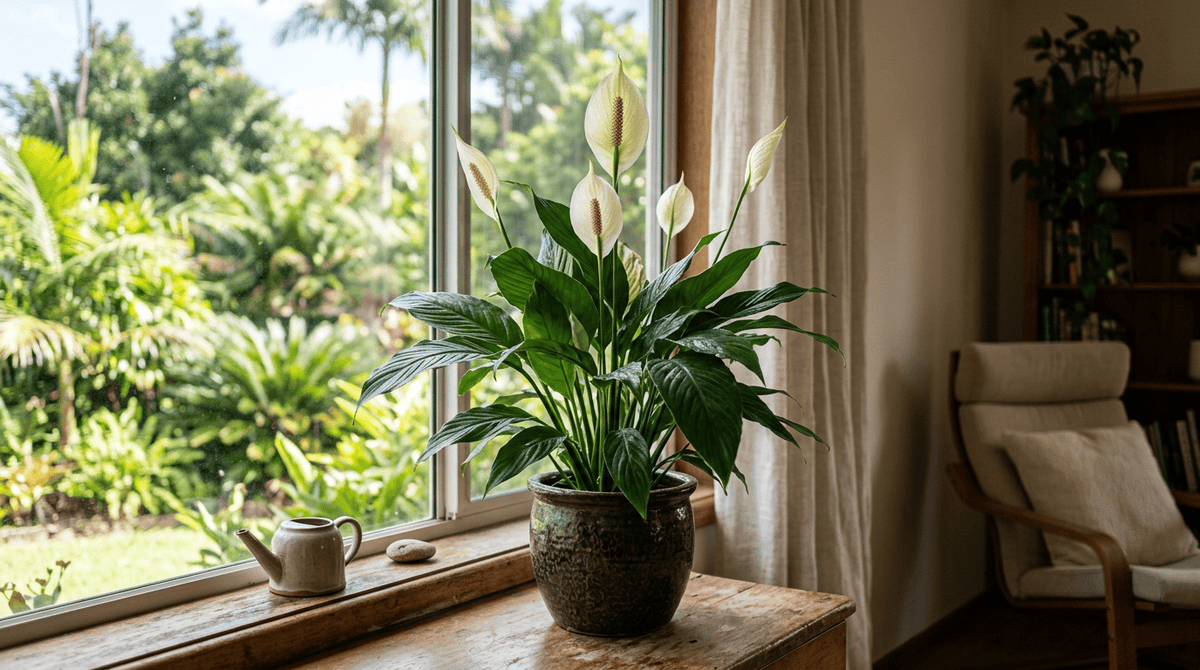
A Peace Lily grows best in bright, indirect light. It can survive in lower-light conditions, but growth may slow and flowering may become infrequent. Harsh direct sunlight, particularly during the afternoon, can scorch its leaves.
Understanding Peace Lily light requirements means finding a location that is bright enough to support healthy foliage and flowers without exposing the plant to intense heat or direct sun. The ideal location may change with the season, so the plant’s growth and leaf condition should guide you.
How Much Light Does a Peace Lily Need?
So, how much light does a Peace Lily need each day? It should receive several hours of bright, filtered light rather than a fixed number of hours in direct sun.
Suitable indoor locations include:
-
Near an east-facing window
-
A few feet from a bright south- or west-facing window
-
Behind a sheer curtain in an intensely sunny room
-
Near a large window shaded by trees or a roof overhang
-
Beneath a grow light when natural light is limited
Window direction is only a starting point. Curtains, trees, overhangs, window tint, neighboring buildings, and seasonal changes can dramatically affect the usable light reaching a plant.
Our complete Peace Lily care guide explains how light works with watering, soil, temperature, and nutrition.
Do Peace Lilies Need Sun?
People frequently ask, “Do Peace Lilies need sun?” They need light for photosynthesis, but they do not require prolonged direct sunlight.
Bright indirect light is generally safer than direct sun. Gentle early-morning sunlight may be tolerated, especially when a plant has been introduced to it gradually. Intense midday or afternoon sun is much more likely to damage the foliage.
UF/IFAS recommends bright, indirect light and no direct sun in its Florida Peace Lily care guidance. These conditions resemble the filtered light Peace Lilies receive beneath taller tropical vegetation.
Direct sun passing through a window can be surprisingly intense. Glass does not prevent the buildup of heat near the leaves, particularly beside an unshaded south- or west-facing window.
How Much Sun Does a Peace Lily Need?
The answer to “How much sun does a Peace Lily need?” depends on the intensity and timing of the exposure. Mild morning sun is very different from several hours of direct afternoon sunlight.
A Peace Lily generally needs little or no direct sun. If it receives any, early morning is typically the safest time.
Signs of excessive sunlight include:
-
Pale or bleached areas
-
Dry tan or brown patches
-
Crispy leaf edges
-
Curling leaves
-
Wilting while the soil remains moist
-
Damage concentrated on the window-facing side
-
Leaves angled away from the strongest light
Sunburned tissue will not become green again. Move the plant farther from the window or filter the light with a sheer curtain. Watch the new growth to determine whether the adjusted location is suitable.
Do not automatically water a sun-stressed plant. Damaged leaves may look dry even while the soil remains moist. Adding water to wet soil can create a second problem.
What Does Bright, Indirect Light Mean?
Bright, indirect light illuminates the plant clearly without strong rays of sun striking its leaves for an extended period.
A simple shadow test can help you evaluate a location. Hold your hand between the window and the plant during the brightest part of the day:
-
A faint, soft-edged shadow suggests indirect light.
-
A distinct but slightly blurred shadow suggests bright indirect light.
-
A sharp, dark shadow indicates strong direct light.
-
Almost no visible shadow may indicate a dim location.
This test is only a practical estimate because light changes throughout the day and year. Check the location at several different times rather than judging it once.
You can also observe how easily you can read in the area without switching on a lamp. If the room feels dim to you throughout the day, it is probably also dim for the plant.
Can a Peace Lily Grow in Low Light?
A Peace Lily can tolerate low light, but tolerance does not mean it will perform at its best. This distinction is important because Peace Lilies are frequently marketed as plants for dark rooms.
In a dim location, the plant may develop:
-
Slow or stalled growth
-
Few or no flowers
-
Smaller new leaves
-
Weak growth leaning toward a window
-
Soil that remains wet longer
-
Greater vulnerability to overwatering
A Peace Lily kept in lower light can still be attractive, especially when grown for its foliage. However, anyone hoping for regular flowers should provide brighter filtered light.
Low light also reduces the amount of water a plant uses. If you move a Peace Lily into a darker location, expect its soil to dry more slowly.
Our guide to how often you should water a Peace Lily explains how available light, container size, temperature, and season affect watering frequency.
Does More Light Help a Peace Lily Bloom?
Yes. Insufficient light is one of the most common reasons a healthy Peace Lily produces foliage but no flowers.
Clemson Cooperative Extension reports that Peace Lilies tolerate low-light conditions but grow best in bright, indirect light. Its Peace Lily growing guide also identifies insufficient light and plant immaturity as common reasons for a lack of flowering.
If a mature Peace Lily has healthy, dark-green foliage but has not flowered for an extended period, move it gradually toward brighter filtered light. Do not immediately increase fertilizer. More fertilizer cannot compensate for inadequate light and may damage the roots.
Give the plant time to respond. New flowers will not necessarily appear as soon as the location changes.
For a complete flowering diagnosis, read our guide to getting a Peace Lily to bloom again.
Where Should You Place a Peace Lily Indoors?
The best position depends on window direction, distance from the glass, and any objects filtering the light.
East-Facing Windows
An east-facing window is often an excellent choice. It generally provides bright light and gentle morning sun without the intense heat associated with afternoon exposure.
Place the plant near the window and monitor the leaves. A sheer curtain may be needed if the window is large, unshaded, or especially bright.
South-Facing Windows
South-facing windows can provide abundant light throughout the day. Position the Peace Lily several feet back or use a sheer curtain to prevent direct rays from striking the leaves.
The correct distance will depend on the window’s size, tint, overhangs, and surrounding shade.
West-Facing Windows
West-facing windows receive strong afternoon light and can become hot. Keep the plant away from the glass and filter the light, especially during summer.
Watch for bleaching, dry patches, curling, or sudden wilting in the afternoon.
North-Facing Windows
A large, unobstructed north-facing window may provide suitable moderate light. A small north window shaded by trees or buildings may be too dim for active growth and flowering.
If a Peace Lily near a north window grows slowly or stops flowering, move it closer to the glass or supplement the location with a grow light.
Should You Rotate a Peace Lily?
Peace Lilies naturally grow toward their strongest light source. Over time, one side may become fuller or lean toward the window.
Rotate the container approximately one-quarter turn every week or two to encourage balanced growth. Avoid changing its location constantly; rotating it in the same suitable spot is usually enough.
If the plant leans dramatically after only a short time, the room may be too dark. Rotation will not solve insufficient light.
Can You Use a Grow Light for a Peace Lily?
Yes. A full-spectrum LED grow light for Peace Lily plants can supplement a dim window or provide their primary source of light.
When comparing grow lights for Peace Lily plants:
-
Choose a full-spectrum LED intended for growing plants.
-
Follow the manufacturer’s recommended hanging distance.
-
Use a timer to provide a consistent schedule.
-
Start with moderate exposure and monitor the foliage.
-
Adjust the distance if the plant stretches or becomes pale.
-
Keep the fixture from heating or touching the leaves.
A common starting point is approximately 10 to 12 hours of artificial light per day. However, the intensity of the fixture and its distance from the foliage are just as important as operating time.
A weak light placed too far away may provide little usable energy. Conversely, an intense fixture positioned too close can bleach or stress the leaves.
If natural light is available, a grow light can supplement it during darker morning or evening hours rather than operating all day.
Do Peace Lily Light Needs Change With the Season?
Yes. Day length and sun angle change during the year, even when the plant remains beside the same window.
Winter light is usually weaker and available for fewer hours. A Peace Lily may benefit from being moved closer to a window or receiving supplemental artificial light.
During summer, that same window may become too hot or intense. A sheer curtain or greater distance from the glass may be necessary.
Seasonal light changes also affect watering. Soil typically dries more slowly when light and growth decrease. Continue checking the potting mix rather than maintaining the same watering schedule all year.
Can You Move a Peace Lily Into Brighter Light?
Yes, but increase its exposure gradually. A plant that has adapted to a dim room can burn when moved suddenly into a much brighter location.
Move it closer to the window in stages over one or two weeks. Monitor the leaves for pale areas, curling, dry patches, or persistent wilting.
Gradual acclimation is also important when moving a Peace Lily outdoors. Even a shaded patio may be much brighter than its previous indoor location.
Peace Lily Sunlight Needs in Florida
Florida sunlight is intense, even through windows and screened enclosures. A location that works well in a cooler climate may expose a Peace Lily to excessive heat and light here.
For safe Peace Lily sunlight exposure in Florida:
-
Avoid direct midday and afternoon sun.
-
Use a sheer curtain near intensely sunny windows.
-
Provide full shade or dappled light on patios.
-
Protect plants from heat reflected by walls and pavement.
-
Move indoor plants outdoors gradually.
-
Check the soil before responding to heat-related wilting.
Our guide to whether Peace Lilies can live outside in Florida explains outdoor placement, temperature limits, rainfall, drainage, and cold protection.
If the plant is already limp, determine why your Peace Lily is drooping before changing its watering routine.
Finding the Right Peace Lily Light
The ideal Peace Lily light is bright, indirect, and consistent. Low light may keep the plant alive, but brighter filtered light supports stronger growth and more reliable flowering.
Watch the plant rather than relying solely on its distance from a window. Stretching, slow growth, persistently wet soil, and a lack of flowers may indicate insufficient light. Bleached areas, crispy patches, and window-facing damage suggest excessive direct sun.
Once you find a location that produces healthy new leaves without scorching, avoid unnecessary changes. Consistent conditions make it easier to understand the plant’s watering needs and recognize future problems.
Explore our Florida-grown Peace Lily plants for sale, shipped directly from our nursery and supported by our complete Peace Lily care library.


